
 Español
 Français

Argentina and Chile are no exception to the rule; like so many other countries, they have scars highlighting significant events.
The Mapuches
The Mapuches live mainly in the rural areas of the Araucanía region as well as in the Lakes region and the metropolitan region, i.e. the capital, Santiago de Chile. Originally from the Chilean Andes, they spread their culture to the “Het” and “Tehuelches” tribes, from La Pampa to Argentine Patagonia, between the 18th and 19th centuries. Neither the Incas nor the Conquistadors succeeded in subduing them. The beliefs of the Mapuche people are based on the worship of ancestral spirits, and spirits and/or elements of nature. These spirits do not correspond to “deities” as one might understand. Despite the number of “beings” present in their beliefs, they have never erected pantheons in their image as is the case in other civilizations of Andean origin.
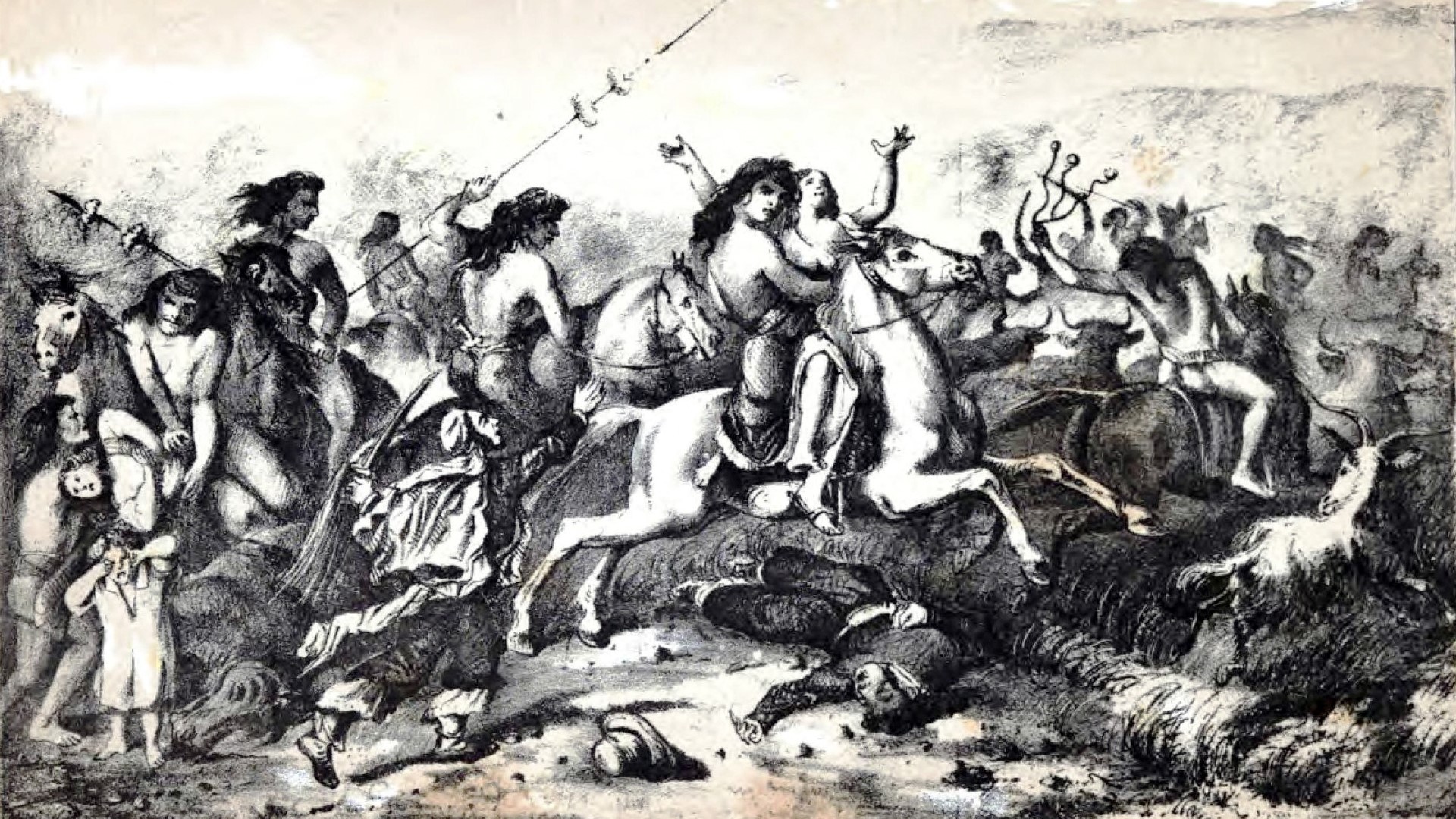
Around 1880, Argentina and Chile undertook wars of conquest against the natives (Mapuche and Patagonians) who lived in the south of the continent in uncontrolled and difficult to penetrate regions. These wars of extermination, which left tens of thousands of natives dead, also pursued another objective: access to “bi-oceanity”. Chile wanted to open up to the Atlantic from the south and Argentina to the Pacific, again from the south.
Mapuche resistance continues today, and currently, around 400 Mapuche activists are charged and/or imprisoned following their mobilization to save ancestral lands from large logging companies and hydroelectric dam projects. Ultimately, the border was stabilized in its current form at the end of the 19th century. In the Argentine zone, the pacification led by the future Argentine president, Julio Argentino Roca, was also cruel.
Julio Roca began his military career in 1858. A veteran of the fratricidal war between Buenos Aires and the Argentine Confederation that took place from 1859 to 1861, he also participated in the War of the Triple Alliance against Paraguay from 1865 to 1870, a war in which he lost his father and two brothers.
Roca was given charge of the Ministry of War. On August 14, 1878, he adopted a plan for an offensive war against the natives living in Patagonia, with the aim of increasing the territory under effective Argentine sovereignty. It was also about beating Chile, which had long been eyeing these territories that had never yet been submitted.
He developed the misnamed “Conquest of the Desert” (1879-1884), which modern scholars have called a clear act of genocide and ethnic cleansing. The very name of the campaign reflects how indigenous peoples were perceived at the time: as savages who had only to be exterminated since, despite their presence on these inhabited lands, these lands were called a desert.
Roca, at the head of a powerful, modern and well-trained army, managed to subdue Patagonia by overcoming the stubborn resistance of the Mapuche people, causing a terrible number of victims. It’s estimated that the war was the direct cause of the deaths of more than 20,000 non-combatant indigenous people.
But victory alone was not enough for him. The survivors were deported far away, to the most sterile regions of Patagonia and elsewhere. Some 3,000 natives (men and women) were taken prisoner and deported to Buenos Aires, where they were separated by sex, in order to prevent them from procreating children.
Argentina had thus acquired millions of hectares of new land. These enormous estates were sold at low prices, or simply offered to influential politicians and large landowners. To justify such a cruel operation, it was alleged that these territories were about to be conquered by Chile, since they were partially the object of a dispute between the two countries, and this until the signing of the Argentina-Chile Treaty of 1881.
The Falklands War
The Falklands War was a conflict between Argentina and the United Kingdom over the Falkland Islands, between March and June 1982. Although surprised by the Argentine attack on the islands, the United Kingdom reacted and expelled the Argentine troops. In Argentina, the failure contributed to the fall of the military junta and the restoration of a democratic regime. To boost its popularity, the military regime launched the Falklands War. It apparently believed it had the support of Washington, without which it would never have dared to attack Great Britain.
Margaret Thatcher‘s response was not long in coming, and the bitter defeat of the Argentine army led to the fall of the military regime. However, the democratic transition did not happen immediately; if we even consider it complete today (although the military remains free and a new disappearance, against a key witness, took place in… 2006).
After tensions with Britain and a beleaguered dictatorial regime, Argentina invaded the islands in April 1982, but was driven out less than 3 months later by the British response to the Falklands War. Although public opinion in the United Kingdom supported the intervention, the international community was more divided. For some states, it was a conflict between a colonial power and a regional state.
However, due to its dictatorial nature, the Argentine regime struggled to gain support. Fear of having their borders called into question brought a majority of states at the United Nations in favor of the United Kingdom. On 10 April, the European Economic Community voted for sanctions against Argentina.
The Mothers’ Movement from Plaza de Mayo
The Mothers of the Plaza de Mayo Movement (in Spanish: “Asociación Madres de la Plaza de Mayo”) is an association of Argentine mothers whose children “disappeared”, murdered under the military dictatorship of the years 1976-1983, during the Dirty War.
The military has admitted that more than 9,000 kidnapped people remain unacknowledged. Since the fall of the dictatorship, the civilian government has estimated the number of missing at 11,000. For their part, the mothers of the Plaza de Mayo estimate that the number is close to 30,000.
The Mothers of the Plaza de Mayo is the only women’s organization in Argentina, a human rights activist. For almost thirty years, mothers have fought to find their children kidnapped by the military dictatorship. As a sign of protest, they wear white scarves (originally: their babies’ cloth diapers)… to remember the disappearance of their children.
The name of the organizations comes from the Plaza de Mayo (May Square) in the center of Buenos Aires. They gather every Thursday afternoon and circle the square for half an hour, counterclockwise, symbolically turning back time and criticizing the impunity of the military responsible for the massacres and torture.
The Association of Mothers of the Plaza de Mayo was formed in the hope of finding the missing sons and daughters, kidnapped by agents of the Argentine government during the Dirty War, from 1976 to 1983. Most were tortured and killed. The first demonstrations in the Plaza de Mayo, in front of the Casa Rosada presidential palace, took place on April 30, 1977.